Truck Crane Hydraulic Cylinder refers to a hydraulic actuator that converts pressurized oil into controlled linear movement on a truck-mounted crane. These cylinders raise and lower the boom, extend telescopic sections, position a folding jib, and deploy outriggers. In practical terms, the correct cylinder improves lifting capacity, stability, cycle time, and operator safety—directly affecting a crane contractor’s productivity and operating cost.
For buyers, fleet managers, and OEM engineers asking, “What Types of Hydraulic Cylinders Are Used on Truck Cranes?”, the answer depends on the crane’s motion, rated load moment, boom geometry, installation space, and duty cycle. Jiaheng manufactures and supplies customized hydraulic cylinder solutions for mobile equipment, including cylinders designed for high-load, outdoor, and repetitive applications.
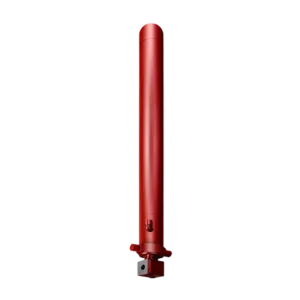
Why Truck Cranes Depend on Hydraulic Cylinders
Truck cranes combine a commercial truck chassis with a hydraulic crane system. Unlike a fixed factory crane, the equipment must withstand road vibration, changing ground conditions, weather exposure, and frequent setup and teardown. Hydraulic cylinders provide high force in a compact package and allow smooth, proportional control through directional control valves and hydraulic pumps.
The operating principle is straightforward:
- The hydraulic pump draws oil from the reservoir.
- Pressurized hydraulic fluid enters one side of the cylinder.
- The piston and piston rod convert fluid pressure into linear force.
- Valves regulate speed, direction, and load holding.
- Return oil flows back to the tank through the hydraulic circuit.
In a mobile crane, the cylinder is not an isolated component. It works with load-holding valves, counterbalance valves, pilot-operated check valves, hose assemblies, pins, bushings, and structural weldments. A correctly selected Truck Crane Hydraulic Cylinder therefore supports both mechanical performance and the overall safety function of the crane.
Main Types of Hydraulic Cylinders Used on Truck Cranes
1. Boom Lift or Boom Elevation Cylinders
Boom lift cylinders, also called boom hoist cylinders, raise and lower the main boom. They are usually mounted between the crane base or pedestal and the boom foot or an intermediate bracket. Because they handle a substantial overturning moment, they are among the most highly loaded cylinders on the machine.
Typical design features include:
- Large bore diameter for high extension force.
- High-strength honed cylinder tube.
- Chrome-plated or induction-hardened piston rod.
- Spherical bushings or articulated mounting eyes to accommodate misalignment.
- Counterbalance or pilot-operated check valves to prevent uncontrolled boom descent.
- Heavy-duty rod seals and wipers for dust, rain, and construction-site contamination.
A boom lift cylinder must be sized using the cylinder force, installation angle, lever arm, boom weight, suspended load, and dynamic factor—not simply the crane’s nominal lifting capacity.
2. Telescopic Boom Extension Cylinders
Telescopic boom cylinders extend and retract nested boom sections. Depending on the crane architecture, the system may use one single-stage cylinder with mechanical cable or chain synchronization, or multiple cylinders for direct extension of several sections.
These cylinders require careful attention to:
- Stroke length and retracted length.
- Rod buckling resistance under compression.
- Synchronization between boom sections.
- Low-friction seal performance.
- Hydraulic cushioning at the end of stroke.
- Protection against side loading and lateral deflection.
Telescopic boom cylinders often operate in a contaminated environment. A damaged wiper can allow abrasive particles to enter the rod seal, causing leakage and accelerated wear. For this reason, surface finish, chrome thickness, guide-ring design, and contamination control are critical procurement requirements.
3. Outrigger and Stabilizer Cylinders
Outrigger cylinders deploy the crane’s stabilizer beams and jack legs. Some truck cranes use separate horizontal extension cylinders and vertical jack cylinders. The horizontal cylinder positions the outrigger beam, while the vertical cylinder transfers chassis load to the ground.
Outrigger cylinders are essential because they establish the crane’s working footprint and reduce chassis movement during lifting. Their main requirements include:
- High resistance to compressive loads.
- Reliable load holding during stationary lifting.
- Robust rod protection against impact and mud.
- Mechanical or hydraulic locking provisions where required.
- Compatibility with outrigger control manifolds and safety interlocks.
A common engineering error is to judge an outrigger cylinder only by its rated thrust. The complete stabilizer assembly must also be checked for ground pressure, structural stress, pin shear, local buckling, and uneven support conditions.
4. Jib Folding and Jib Positioning Cylinders
Truck cranes equipped with lattice jibs, fly jibs, or hydraulic folding extensions may use smaller hydraulic cylinders to fold, unfold, or position the jib. These cylinders normally experience lower loads than boom lift cylinders, but they may have long strokes and challenging mounting angles.
Jib positioning cylinders must provide controlled movement during installation and removal. They also need suitable cushioning and accurate end-of-stroke control to prevent shock loading. In many designs, a pilot-operated check valve is used to help hold the jib in position if hydraulic pressure is lost.
5. Auxiliary or Attachment Cylinders
Depending on the truck crane configuration, additional cylinders may operate:
- Hydraulic folding platforms or material-handling attachments.
- Grabber, clamshell, or lifting accessory mechanisms.
- Service decks and access systems.
- Special-purpose boom heads or tool interfaces.
These are still part of the broader Truck Crane Hydraulic Cylinder category, but their bore, stroke, mounting, and duty cycle are determined by the attachment rather than the primary crane structure.
Truck Crane Hydraulic Cylinder Types at a Glance
| Cylinder type |
Primary function |
Typical design priority |
Common protection |
| Boom lift cylinder |
Raises and lowers the main boom |
High force and load holding |
Counterbalance valve, heavy-duty seals |
| Telescopic boom cylinder |
Extends and retracts boom sections |
Long stroke, buckling resistance, synchronization |
Rod wiper, polished or chrome-plated rod |
| Outrigger cylinder |
Deploys beams and stabilizer legs |
Compression strength and stability |
Check valve, rod guard, robust mounting |
| Jib cylinder |
Folds or positions the jib |
Controlled motion and compact installation |
Cushioning and pilot-operated check valve |
| Auxiliary cylinder |
Operates special attachments |
Application-specific force and stroke |
Selected according to the attachment environment |
How to Select the Correct Jiaheng Truck Crane Hydraulic Cylinder
Once the cylinder function is identified, the selection process should move from operating data to engineering validation. A qualified supplier such as Jiaheng should review the following information before recommending a design:
- Operating pressure: Specify nominal and peak pressure, including transient pressure spikes.
- Bore and rod diameter: Calculate extension and retraction force, then verify rod buckling and fatigue strength.
- Stroke and retracted length: Confirm the cylinder fits the crane geometry throughout the complete movement range.
- Mounting configuration: Define pin diameter, eye width, trunnion, flange, clevis, or spherical bearing requirements.
- Duty cycle: State cycles per hour, operating temperature, load spectrum, and expected service life.
- Environment: Consider dust, water, salt spray, mud, ultraviolet exposure, and road vibration.
- Valve integration: Select suitable counterbalance, lock, cushioning, and emergency lowering arrangements.
For precision hydraulic components, dimensional control may be managed to a tolerance of 0.01 mm on selected machined features, subject to the drawing and application requirement. A robust quality program should also include 100% visual and dimensional inspection, pressure testing of every finished assembly, and traceability for seals, tubes, rods, and weldments.
Manufacturing and Quality Considerations
Hydraulic cylinder reliability depends on more than the nominal material grade. The manufacturing process normally includes tube honing, rod machining and surface treatment, welding, assembly, seal installation, cleaning, and pressure testing.
Important Quality Checks
- Dimensional inspection: Bore, stroke, rod diameter, concentricity, mounting dimensions, and thread profiles.
- Surface inspection: Rod roughness, chrome condition, pitting, scratches, and seal-contact quality.
- Weld inspection: Visual inspection and, where specified, non-destructive testing such as magnetic particle or ultrasonic examination.
- Pressure testing: Proof and leakage tests based on the approved hydraulic design and customer specification.
- Cleanliness control: Internal flushing and contamination control to protect valves and pumps.
- Functional testing: Full extension, retraction, cushioning, and leakage checks.
Relevant references can include ISO 10100 for hydraulic fluid power cylinder acceptance tests and ISO 6020/2 or ISO 6022 where the cylinder design falls within those dimensional or heavy-duty series. Material verification may use applicable ASTM methods, while dimensional and quality documentation may also reference DIN or ISO tolerancing practices. The exact standard should be agreed in the technical specification rather than assumed.
For export projects, buyers should request a certificate of conformity, inspection records, pressure-test data, material certificates where required, and a clear warranty process. Jiaheng customers can also ask for application review and technical support; a supplier response target such as 24 hours is a useful service benchmark when production downtime is costly.
Common Misconceptions About Truck Crane Cylinders
Misconception 1: A Larger Bore Always Makes the Cylinder Better
A larger bore increases theoretical extension force, but it also increases weight, oil consumption, installation space, and structural load. The correct bore is determined by force calculations and the crane’s hydraulic flow—not by size alone.
Misconception 2: Hydraulic Pressure Equals Lifting Capacity
Pressure is only one part of the load calculation. Actual lifting performance is also limited by boom geometry, rated load moment, chassis stability, structural strength, outrigger spread, and safety factor.
Misconception 3: Any Cylinder With the Same Stroke Will Fit
Two cylinders with identical stroke lengths may have different retracted lengths, mounting centers, ports, pin sizes, rod diameters, and allowable side loads. Replacing a cylinder requires a complete dimensional and hydraulic comparison.
Misconception 4: A Hydraulic Motor Is a Hydraulic Cylinder
The crane winch commonly uses a hydraulic motor to create rotary motion. A hydraulic cylinder creates linear motion. The winch, boom cylinders, valves, and load-control devices must be evaluated as separate but interconnected components.
Illustrative Fleet Case: Choosing a Replacement Cylinder
Consider a 25-ton truck crane experiencing oil leakage at the boom lift cylinder. The fleet manager initially requests a replacement with the same stroke. During engineering review, the supplier identifies that the original cylinder has a worn rod surface, deteriorated wiper, and insufficient protection for a coastal operating environment.
The improved replacement specification includes:
- Verified bore and rod dimensions based on the crane manufacturer’s drawing.
- Chrome-plated rod with a corrosion-resistant surface treatment.
- Updated rod seal and wiper compatible with the approved hydraulic oil.
- New load-holding valve arrangement reviewed by the crane engineer.
- 100% pressure and leakage inspection before shipment.
- Documented dimensional inspection with selected features controlled to 0.01 mm.
The lesson is important: a successful replacement is not simply a part swap. It is a system-level review of load, geometry, sealing, contamination, safety valves, and operating environment.
Maintenance Practices That Extend Cylinder Service Life
Even a well-designed Truck Crane Hydraulic Cylinder can fail early if maintenance is neglected. Operators and service teams should:
- Inspect the piston rod for scoring, corrosion, dents, and oil film changes.
- Check welds, mounting pins, bushes, and spherical bearings for looseness.
- Monitor hydraulic oil cleanliness and replace clogged filters.
- Never use the cylinder as a structural stop unless the design specifically allows it.
- Keep outrigger rods clean before retraction.
- Investigate drift, abnormal noise, jerky motion, and excessive heat immediately.
- Depressurize the system before removing hoses or dismantling a cylinder.
Final Answer: What Types of Hydraulic Cylinders Are Used on Truck Cranes?
The main types are boom lift cylinders, telescopic boom extension cylinders, outrigger and stabilizer cylinders, jib folding or positioning cylinders, and auxiliary attachment cylinders. Each type has a different load path, stroke requirement, mounting arrangement, and safety function.
When sourcing a Truck Crane Hydraulic Cylinder from Jiaheng, provide the crane model, operating pressure, bore, rod diameter, stroke, mounting dimensions, hydraulic port details, duty cycle, and environmental conditions. With correct engineering review, standards-based inspection, and documented testing, the cylinder can deliver safer operation, longer service life, and lower total ownership cost. For a replacement or custom design, explore Jiaheng’s hydraulic cylinder capability and request a technical review before placing the order.